We are BoB

We are BoB

Welcome, Museum für Regionalgeschichte der Gemeinde Scharbeutz!
Great, you are Best of Baltic, your score is
70
For 2026 the minimum score is
27
In 2027 the minimum score will be
42
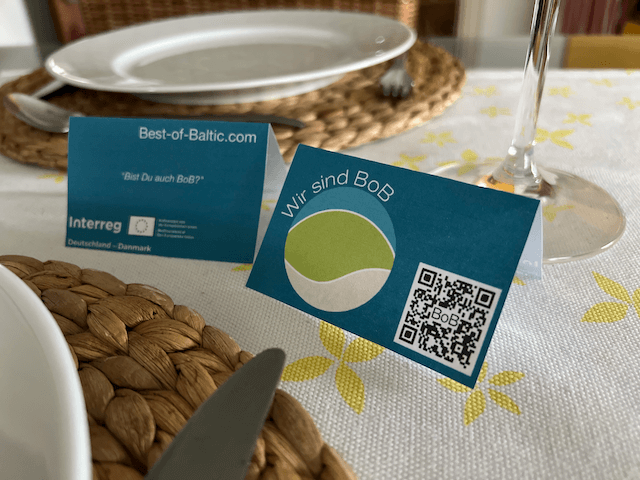
Das Museum für Regionalgeschichte sammelt und präsentiert Objekte aus der Geschichte der Region. Es verfügt über eine umfangreiche Bibliothek und ein Archiv. Die Dauerausstellung mit Exponaten aus der Jungsteinzeit, dem Mittelalter (Slawenzeit) und dem 19. und 20. Jahrhundert (Volkskunde) wird ergänzt durch Sonderausstellungen zu aktuellen Themen, wie z. B. Munition im Meer - Das explosive Erbe.
Energy
LED lamps
2
(0) none at all, (1) older energy-saving lamps, (2) argely LED, (3) complete LED lighting
(0) none at all, (1) older energy-saving lamps, (2) argely LED, (3) complete LED lighting
LED 'light bulbs' are now available for really all lamps, even with pleasantly warm light colors. Also, think about the lights outside - are they LED as well?
0.23
Motion detector
1
(0) none, (1) less than half, (2) more than half, (3) everywhere
(0) none, (1) less than half, (2) more than half, (3) everywhere
Motion detectors make sense in all rooms including outdoor areas, where we potentially let the light burn for too long, for example in the hallway, basement, garage, etc. Of course, it is important that the light does not stay on for too long.
0.16
Avoidance of stand-by times
1
(0) not at all, (1) for some devices, (2) for most, (3) for all
(0) not at all, (1) for some devices, (2) for most, (3) for all
Standby power consumption is often reminded and extrapolated. For example, if a screen consumes 5 watts in standby, that is 120 watt hours (Wh) per day, i.e. about one eighth of a kilowatt hour (35 cents/kWh). Companies can quite easily calculate for themselves what savings potential all their computers, screens, beamers and even routers have if they do not use StandBy.
0.16
Let the light burn unnecessarily
3
(0) happens constantly, (1) happens frequently, (2) happens rarely, (3) never happens
(0) happens constantly, (1) happens frequently, (2) happens rarely, (3) never happens
Modern lamps require little electricity, and yet it is worthwhile not to let them burn unnecessarily, for example when we are not in the room for a long time. Corridors, toilet rooms, cellars often have the light burning unnecessarily. In some indoor and outdoor areas, companies also sometimes have the light on too long or too early.
0.08
Renunciation of extreme power consumers
2
(0) have many, (1) have more than two, (2) have one, two (3) have no
(0) have many, (1) have more than two, (2) have one, two (3) have no
Apart from the fact that every device can have a high power consumption, a refrigerator is not regularly defrosted, the door seal is leaking, the washing machine is driven with too high temperatures and spin numbers, etc., there are still some unnecessary things that consume a lot of electricity:
In the company, these can be exaggerated light installations, electric bollards, and much more.
0.39
Housing, Buildings
Natural building materials and paints
3
(0) not at all, (1) with less than half, (2) with more than half, (3) with everything
(0) not at all, (1) with less than half, (2) with more than half, (3) with everything
Building materials such as concrete, plaster, steel or even aluminum have a high ecological footprint and mean many greenhouse gases. The foamed insulation materials are also in the criticism. In addition, the negative consequences of conventional paints and adhesives are often unknown, which then lead to toxic exhaust gases in waste incineration plants due to ultimately ineffective filters. Natural building materials and colors are significantly more expensive, although the non-natural materials are often extremely expensive when it comes to disposal. So it is the good feeling, the better smell and the healthier building biology that make us do the right thing here.
1.37
Lowered living room temperature (without mold)
3
(0) over 20 degrees, (1) 19-20, (2) 18, (3) 17
(0) over 20 degrees, (1) 19-20, (2) 18, (3) 17
In most study rooms it is too warm in winter - we walk around in a T-shirt instead of putting on thick sweaters and a cardigan. The energy-saving potential is considerable. When lowering the temperature, attention must be paid to the indoor climate and the possible risk of mold formation. This depends above all on the humidity.
Companies also have to observe workplace regulations.
0.55
Waiver of air conditioning
3
(0) not at all, (1) less than 50%, (2) more than 50%, (3) 100% of the rooms
(0) not at all, (1) less than 50%, (2) more than 50%, (3) 100% of the rooms
Air conditioning systems are also gaining in importance in temperate latitudes. Intelligent construction and ventilation and the use of thermal protection roller blinds can avoid these power guzzlers.
In warm regions, a corresponding education of the guests can take place. Often a fan is also useful.
0.39
Nutrition
Food from the region
3
(0) not at all, (1) less than 50%, (2) more than 50%, (3) 100% of food
(0) not at all, (1) less than 50%, (2) more than 50%, (3) 100% of food
Food from the region, from the weekly market and from the farm shop have not been transported far (there are of course also exceptions there) and strengthen the local economy.
However, there are also inefficient short transport routes when vehicles with little load drive to the points of sale. E-mobility and cargo bikes can help here.
Unfortunately, the regional is often also played out against the organic offer: regional, sprayed with pesticides food is not as good as regional organic food, and regional meat is not as good for the environment as the renunciation of meat.
0.23
Tap water
2
(0) not at all, (1) less than 50%, (2) more than 50%, (3) 100% instead of purchased mineral water or soft drinks
(0) not at all, (1) less than 50%, (2) more than 50%, (3) 100% instead of purchased mineral water or soft drinks
Fortunately, tap water has long been a trend. There are drinking water dispensers in schools and the students have their drinking bottles with them, and managers also bring their drinking bottles to workshops. Many children do not even get used to the unhealthy sugar drinks.
Tap water is more strictly controlled than bottled drinks and saves a lot of energy and packaging.
Companies can set up water dispensers - if necessary also work with filters, for example to remove chlorine odors.
1.30
Avoidance of food waste
1
(0) not at all, (1) less than 50%, (2) more than 50%, (3) I save or avoid 100% of the food to be thrown away
(0) not at all, (1) less than 50%, (2) more than 50%, (3) I save or avoid 100% of the food to be thrown away
Food is wasted from the field to the factories and transport routes to the throw away by us, the restaurants and the supermarkets. This ultimately means that more areas are needed for cultivation and thus forests are cut down and biodiversity is endangered with sprays and fertilizers.
We can shop more specifically, throw away goods not only because of the best before date, save food in the household (e.g. freeze bananas or make durable spreads and soups from leftover vegetables yourself), save specifically rescued food (e.g. too small or wrinkled goods) and also donate leftover food in many places, e.g. to the food banks.
Canteens and kiosks and also events can query the demand in advance and thus prevent food from being thrown away. A dish can also be deliberately offered the next day, which advertises the utilization of the leftovers from the previous day.
0.83
Mobility
Waiver of air travel
3
(0) more than one per year, (1) one per year, (2) one every few years, (3) none or less often than every 5 years
(0) more than one per year, (1) one per year, (2) one every few years, (3) none or less often than every 5 years
Flying is a great experience for most people like experiencing distant places. Flying short distances should rightly lead to 'flight shame' - some countries are planning to ban domestic flights completely.
The problem with flying is, on the one hand, that we travel a lot of kilometers, even if the energy requirement per kilometer and person is not so high. On the other hand, greenhouse gases are transported directly to the heights where they harm us.
So we should only use the plane for rare long-distance trips and then rather stay longer in the places. Many, on the other hand, fly several times a year, partly within Europe - some even to sustainability conferences or just to spontaneously escape the harsh weather in Germany. Unfortunately, flying is even subsidized and is often cheaper than train or car.
0.83
Bicycle shelters
2
(0) not at all, (1) for less than 50%, (2) for more than 50%, (3) all can store their bicycles
(0) not at all, (1) for less than 50%, (2) for more than 50%, (3) all can store their bicycles
What has recently been a successful model in some countries and cities is still a problem in Germany: to give cyclists priority over car traffic. The willingness to ride a bike, even in bad weather, is higher than ever. E-cargo bicycles make it possible to at least do without the second car. A company can do a lot from the bicycle shelter with charging possibility via the company bicycle.
0.41
Garbage
Separate garbage consistently
3
(0) not at all, (1) some, (2) mostly, (3) always, even on the go
(0) not at all, (1) some, (2) mostly, (3) always, even on the go
Consistently separating waste, including green waste, glass and paper, is not as self-evident as can be assumed. Many make little effort here and don't really know what belongs in which bin. The residual waste bin also costs the public sector a lot of money, while the recyclable and green waste bin are free of charge. But also special waste, such as batteries, incandescent lamps, electrical appliances, etc. must be disposed of properly.
0.65
Recycling-Paper
1
(0) never, (1) some, (2) mostly, (3) always
(0) never, (1) some, (2) mostly, (3) always
Non-recycled paper is often cheaper, but means cutting of forests, contamination of water during production and a high energy requirement.
Recycled paper for toilet paper, writing paper, packaging, envelopes, wrapping paper, etc. should be a matter of course today. But we have to pay attention to it and choose it.
Recycled paper is also snow-white, but it should then not be bleached with chlorine but oxygen.
1.23
Paperless office/media
1
(0) not at all, (1) some, (2) most, (3) all only digital.
(0) not at all, (1) some, (2) most, (3) all only digital.
Saving paper helps to protect forests - recycling paper also ultimately means more demand for fresh pulp from trees.
We don't even need to print many things in the first place, but can save them on devices that we already have. For internal processes but also for dialogue with customers, digital forms should continue to prevail.
0.61
Land use
Avoidance of surface sealing
1
(0) no consideration, (1) some waiver, (2) a lot of waiver, (3) maximum possible waiver
(0) no consideration, (1) some waiver, (2) a lot of waiver, (3) maximum possible waiver
Surface sealing is a problem not only in growing civilizations, but also in Germany. We live on too much living space, are still building new streets and courtyard driveways and our terraces are also getting bigger and bigger.
To specifically dispense with area, to build in height, water-permeable paving, green roofs (own point) and, weighing up all the advantages and disadvantages, to expand one's own house to the height in order to enable more people to live on the same sealed area, are valuable steps. By the way, an English lawn is ecologically not very valuable, for example, compared to a flower or clover meadow or a vegetable garden.
Companies can systematically look at which areas do not have to be sealed and perhaps can be provided with flower meadows.
0.83
Renaturation
1
(0) not at all, (1) some, (2) most, (3) all
(0) not at all, (1) some, (2) most, (3) all
In many places, moors, streams, etc. have been lost with the settlement and intensification of agriculture. Renaturalizing this often means an enormous gain for biodiversity, climate and also flood protection.
1.04
Insect-friendly flowering plants
2
(0) not at all, (1) in some places, (2) in many places, (3) in all places and possibly also on the go
(0) not at all, (1) in some places, (2) in many places, (3) in all places and possibly also on the go
It is hard to believe that the future of our diet depends on the use of pesticides and their influence on insects that have to pollinate our plants. Many pollinators are threatened with extinction and in addition to the purchase of organic, we can offer these insects flowers on our areas. In fact, some plants are neither bee-nor bird-friendly. On the other hand, fruit trees and most vegetables are already great opportunities to promote bees, bumblebees, etc. At the flower meadows there are one- and multi-year-olds.
0.64
Social
Crafts from the region
3
(0) not at all, (1) sometimes, (2) mostly, (3) always
(0) not at all, (1) sometimes, (2) mostly, (3) always
This is about living and working in the region, about strengthening the community. The birdhouse from a social workshop or the PV system from the electrician on site (if he has further training). The award criteria of the municipalities must of course be legally secure.
If the work is good, a discreet advertising sign can also draw attention to the craft business in return.
1.06
Volunteering
3
(0) not at all, (1) sometimes, (2) much, (3) maximum
(0) not at all, (1) sometimes, (2) much, (3) maximum
Volunteering, whether at the fire brigade, in the sports club or the help in the neighborhood, is enormously important for togetherness and society. Companies can help here to honor volunteering and accompany it through donations.
0.74
Citizens' meeting (clubs, fire brigade, squares)
3
(0) not at all, (1) promote some, (2) promote a lot, (3) maximum each measured by what is basically conceivable.
(0) not at all, (1) promote some, (2) promote a lot, (3) maximum each measured by what is basically conceivable.
Support of clubs, squares and halls for the gathering of citizens
0.12
Refugee care
1
(0) not at all, (1) promote some, (2) promote a lot, (3) maximum each measured by what is basically conceivable.
(0) not at all, (1) promote some, (2) promote a lot, (3) maximum each measured by what is basically conceivable.
Societies must take in refugees - no matter how many there are. To be distinguished from this is the number of those who we can also permanently integrate into our society and also have to with regard to our economy and retirement provision or demographic change. A company should actively anticipate and help to accept people with a migration background within the scope of the legal possibilities. Linguistically, English is sometimes the lowest common denominator that can also be chosen in companies. As far as it is legal, we should help these people.
1.44
Cultural promotion
3
(0) not at all, (1) promote some, (2) promote a lot, (3) maximum each measured by what is basically conceivable.
(0) not at all, (1) promote some, (2) promote a lot, (3) maximum each measured by what is basically conceivable.
Cultural promotion can take place in all facets - from young people who make music to exhibitions to the care of traditional festivals.
0.07
Other Consumption
Used or long-lived furniture
3
(0) not at all, (1) sometimes, (2) often, (3) basically
(0) not at all, (1) sometimes, (2) often, (3) basically
Many furniture cannot stand being moved or even disassembled and reassembled. They are primarily cheap and the business model is that after a few years we want to buy new furniture. Looking at how valuable the furniture is and then being able to repair it takes us a whole lot further on the way to a better world. It is also amazing what good pieces there are on the used market.
1.30
Used, long-used devices
2
(0) not at all, (1) sometimes, (2) often, (3) basically
(0) not at all, (1) sometimes, (2) often, (3) basically
Many devices from vacuum cleaners to cordless screwdrivers to TVs are amazingly inexpensive today. Relying on valuable devices that last a long time, or even buying used devices, helps to save raw materials and energy.
1.30
Repairing instead of buying new
1
(0) not at all, (1) sometimes, (2) often, (3) basically
(0) not at all, (1) sometimes, (2) often, (3) basically
Unfortunately, many devices can no longer be repaired at all, for example if the control unit breaks down from the washing machine and costs more than a new washing machine. And yet there are workshops that also repair mobile phones, washing machines, lawn mowers, etc. - and even if it is as expensive as a new device, it is the good feeling of having done something for a better world again.
0.65