We are BoB

We are BoB

Welcome, MeerReise Camping!
Great, you are Best of Baltic, your score is
71
For 2026 the minimum score is
27
In 2027 the minimum score will be
42

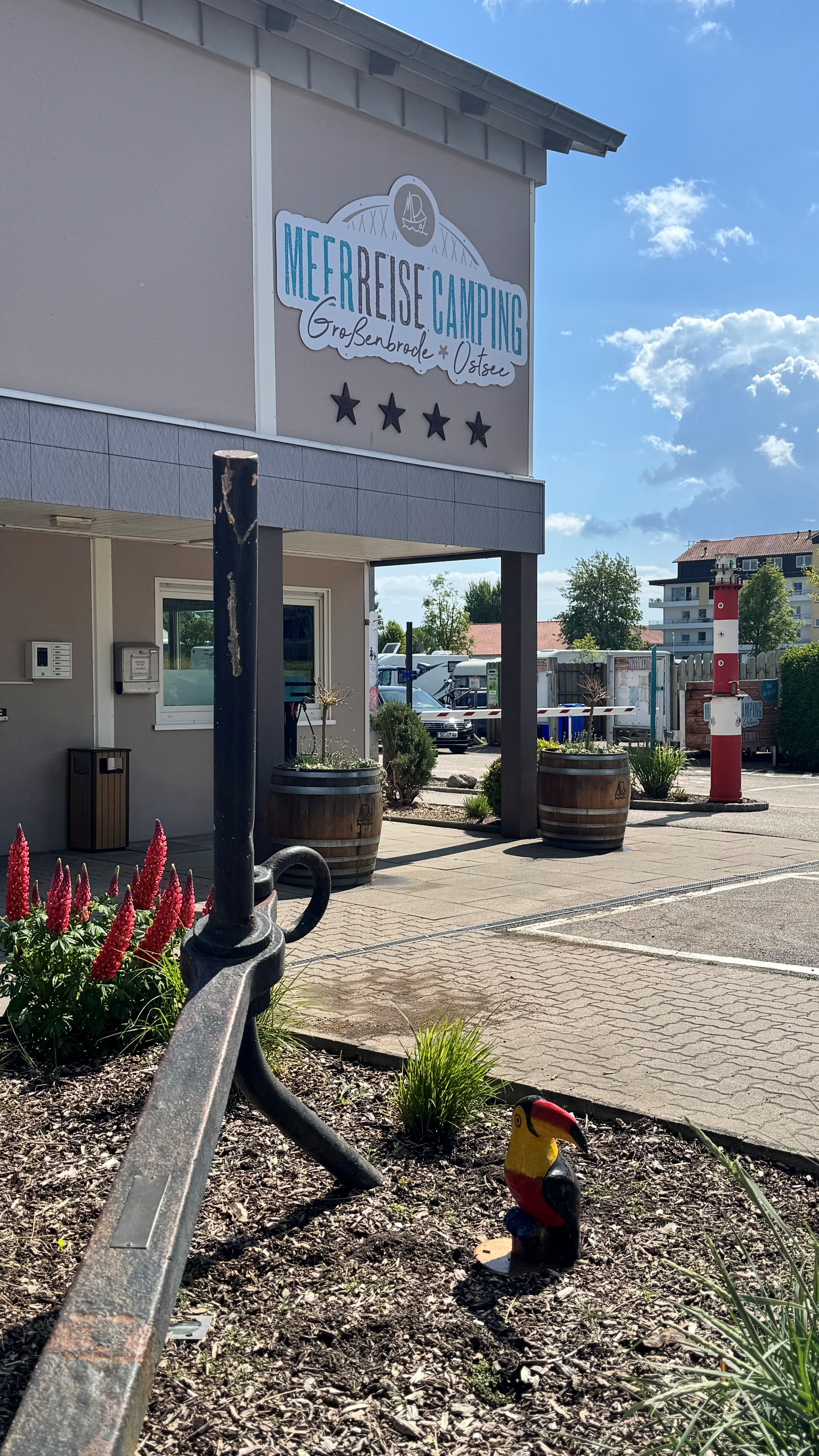
MeerReise Camping ist dein familienfreundlicher Campingplatz direkt an der Ostsee in Großenbrode. Freu dich auf großzügige Standplätze, moderne Mobilheime und Safarizelte, einen Wohnmobilhafen sowie jede Menge Platz zum Entspannen und Entdecken. Nur wenige Schritte vom Strand entfernt erwarten dich maritimes Flair, herzliche Gastfreundschaft und unvergessliche Urlaubsmomente für Groß und Klein.
Energy
Energy-saving devices
3
(0) outdated devices, (1) with old energy-saving seal, (2) with up-to-date and (3) with the latest best value
(0) outdated devices, (1) with old energy-saving seal, (2) with up-to-date and (3) with the latest best value
It is always a consideration whether the further use of an older device does not require less energy or water than the production of a new, energy-efficient device. Therefore, the energy requirement along the entire product life cycle (from production to use to disposal) must be considered.
Sometimes someone needs a different device and can't afford a new one - then a used device from someone who has bought a new, more economical device, of course, also makes sense. With some devices, the top values are only achieved with large quantities, i.e. washing machines with a lot of capacity. It is to see whether the top values also apply with lower filling quantities, for example for single households.
0.23
LED lamps
3
(0) for none at all, (1) for older energy-saving lamps, (2) for largely LED, (3) for complete LED lighting
(0) for none at all, (1) for older energy-saving lamps, (2) for largely LED, (3) for complete LED lighting
LED 'light bulbs' are now available for really all lamps, even with pleasantly warm light colors.
0.23
PV on suitable places
3
(0) not at all, (1) less than 50%, (2) more than 50%, (3) all suitable areas
(0) not at all, (1) less than 50%, (2) more than 50%, (3) all suitable areas
We have to use all suitable areas for photovoltaics (PV), as the variants on open spaces restrict nature and agriculture. A trend is PV on stilts, so that it can still be gardened or cultivated underneath. But that costs building material. Photovoltaics has become amazingly inexpensive today thanks to cheap panels from China. Unfortunately, there is hardly any money to make from the feed into the power grid, currently about 8 cents per kWh in Germany. Therefore, PV should always be combined with its own electricity storage (own step, see below) so that as much electricity as possible is consumed by yourself. This then saves approx. 25 to 35 cents per kWh (depending on your tariff), which we would otherwise have to pay to the electricity provider. In this way, your own PV system, adapted to your own electricity consumption, pays off after just a few years. If you have a car, you should take into account its consumption (even if it is not yet an electric car). Then the savings are much bigger. The banks like to give loans for PV, quite often it is also being subsidized. In addition, there are also providers who take over the costs and virtually rent the roof area and offer discounted electricity in return. Such providers then form so-called virtual power plants with other houses and their batteries. For such a dependency, you should inform yourself well about what is best for you.
1.10
Energy storage
3
(0) not at all, (1) a small storage for one day, (2) a storage for more than one day, (3) a storage also for e-car charging or as a virtual power plant
(0) not at all, (1) a small storage for one day, (2) a storage for more than one day, (3) a storage also for e-car charging or as a virtual power plant
An electricity storage system primarily helps to maximize the yield of the PV system if the electricity is not fed into the grid for little money, but comes out of the battery in the evening and then allows the full electricity price to be saved.
Another advantage may be that some batteries work as an island system in the event of a power outage.
The already mentioned virtual power plants then access your battery from the outside and make the electricity available virtually in the neighborhood and compensate you for it. In addition, power grids are stabilized and even with little wind and no sun, we can consume renewable energies.
Note on lithium: Like many other raw materials, lithium is often problematic during mining. However, the life cycle assessment must take into account that we can recycle lithium for hundreds of years. In the basement, older lithium batteries from the automotive industry could also come to a second life later or, alternatively, sodium batteries that require more space.
0.66
Motion detector
2
(0) none, (1) less than half, (2) more than half, (3) everywhere
(0) none, (1) less than half, (2) more than half, (3) everywhere
Motion detectors make sense in all rooms including outdoor areas, where we potentially let the light burn for too long, for example in the hallway, basement, garage, etc. Of course, it is important that the light does not stay on for too long.
0.16
Avoidance of stand-by times
2
(0) not at all, (1) for some devices, (2) for most, (3) for all
(0) not at all, (1) for some devices, (2) for most, (3) for all
Standby power consumption is often reminded and extrapolated. For example, if a TV consumes 5 watts in standby, that is 120 watt hours (Wh) per day, i.e. about one eighth of a kilowatt hour, which costs about 35 cents. So hardly anyone will get up from the sofa for 5 cents a day and press the switch on the TV, or turn off the WLAN router at night, or shut down the computer. Or is it? And how many watt hours could be saved daily in all households? Would this consideration influence your actions?
0.16
Let the light burn unnecessarily
2
(0) happens constantly, (1) happens frequently, (2) happens rarely, (3) never happens
(0) happens constantly, (1) happens frequently, (2) happens rarely, (3) never happens
Modern lamps require little electricity, and yet it is worthwhile not to let them burn unnecessarily, for example when we are not in the room for a long time.
0.08
Renunciation of extreme power consumers
3
(0) have many, (1) have more than two, (2) have one, two (3) have no
(0) have many, (1) have more than two, (2) have one, two (3) have no
Apart from the fact that every device can have a high power consumption, a refrigerator is not regularly defrosted, the door seal is leaking, the washing machine is driven with too high temperatures and spin numbers, etc., there are still some unnecessary things that consume a lot of electricity:
Tumble dryer, sauna, dehumidifier, pond pumps, aquarium heaters, terrace heaters, etc.
The easiest way is to see to what extent you deviate from the average consumption in Germany and then think about what it is. If you are charging an electric car at home, you should see what can be attributed to it (either the car offers this evaluation or you use a separate electricity meter for this).
0.39
Housing, Buildings
Moderate living space
3
(0) huge ones (1) normal ones (2) smaller ones (3) shared ones
(0) huge ones (1) normal ones (2) smaller ones (3) shared ones
The area that we need to live means the area that is sealed, the building material that is needed, and the space that needs to be heated - and all this against the background of social justice. If you offer an apartment, a holiday house, or a hotel room and additional rooms smaller versions can be a smart choice.
2.11
Insulation
1
(0) more 140kWh/m2a, (1) down to 70, (2) to 15, and (3) for less than 15 kWh/m2a
(0) more 140kWh/m2a, (1) down to 70, (2) to 15, and (3) for less than 15 kWh/m2a
Thermal insulation is extremely important. Investing here means saving energy and costs. The argument that building will then become too expensive must be clearly put into perspective. One way, of course, is to have to insulate smaller living spaces. The other to become generally more efficient when building. Then ecological building materials will also become affordable. Old houses that can no longer be sensibly insulated are perhaps worth so much more as a new building that financing is not a problem. (Note: the figures are for Germany)
1.17
Saving water (showers)
2
(0) long, hot and frequent shower, (1) shorter shower, (2) shorter with water saving showerhead, (3) shorter, with water saving showerhead and colder
(0) long, hot and frequent shower, (1) shorter shower, (2) shorter with water saving showerhead, (3) shorter, with water saving showerhead and colder
Long and hot showers mean water and energy consumption and ultimately high costs. The other effects are even more impressive in the network - or did you know that long showering can be responsible for refugees and the quality of life in Germany?
http://www.imodeler.info/ro? key=Ceju1XNHCFZBJc2MpbAOl5Q
We simply take a Spartaste when flushing the toilet for granted.
0.71
Solar thermal energy
3
(0) not at all, (1) small system, (2) for hot water, (3) for hot water and support of heating
(0) not at all, (1) small system, (2) for hot water, (3) for hot water and support of heating
Solar thermal energy makes it possible to heat water over part of the roof area most of the year and then use it for hot water or even to support heating.
It is quite inexpensive in the actual purchase - only pipes have to be laid and the heat for the hot water or heating must be transferred via a heat exchanger. Since solar thermal energy works mainly in sunshine, it is often suggested to install PV modules on the same surface and to electrically heat water over them. The yield in kW is higher with solar thermal energy, but the installation of PV is easier.
0.66
Mobility
Electric vehicles
2
(0) Internal combustion engine, (1) electric car with more than 100kWh, (2) electric car with more than 50 kWh (3) electric car with less than 51 kWh ... each based on the average of the fleet
(0) Internal combustion engine, (1) electric car with more than 100kWh, (2) electric car with more than 50 kWh (3) electric car with less than 51 kWh ... each based on the average of the fleet
There are almost hostile prejudices against electric cars: child labor, coal power, risk of explosion, farmers are expropriated, fear of range, loss of value, etc. It is true: Like every car, electric cars are also a waste of raw materials and energy. But if car, then the electric car is the best solution, because gasoline and diesel perform even worse in all areas.
Many studies or Statements by laymen make a mistake: The controversial lithium must not only be counted with its footprint from mining, but this must be reduced by the many times that lithium is recycled again and again in the decades. In addition, what few know: Gasoline contains almost the same amount of electrical energy on 100km for production and transport as it is needed in an electric car for the journey.
E-cars would not have to be so expensive and batteries not so big - charging options are more important. Electricity at public charging stations is currently surprisingly expensive, although it would clearly be more important to add the costs of the climate catastrophe and air pollution to the gasoline and diesel price. http://www.imodeler.info/ro? key=Col-EWhyCbIR_KGGP7mXbLw
Hydrogen and synthetic fuels in cars are nonsense. There are so-called memes fuelled by individual interests (keyword "Lex Porsche" https://www.cleanthinking.de/lex-porsche-lindner-wissing-e-fuels/), 'ego trolls', which are picked up by 'Troll-Lemmingen', who simply like to be against something and do not want to change. With both fuels, green electricity is first generated and then with loss of efficiency to hydrogen or e-fuel. For e-fuels, carbon is also missing - already today, few airlines that have started with it have a problem buying carbon on the market.
Consideo has also gained important insights about hydrogen:
https://www.consideo.com/files/consideo/pdfs/papers/eng/ConsideoPaper-BEM-Engl.pdf
In companies, of course, electric cars are also associated with additional expenses. However, if the electricity itself is produced, the self-consumption of electricity can be maximized and the costs are even lower in the end.
2.60
Charging stations for electric cars
3
(0) not at all, (1) less than 50%, (2) more than 50%, (3) for all guests/employees
(0) not at all, (1) less than 50%, (2) more than 50%, (3) for all guests/employees
If you do not have a garage or courtyard entrance with your own socket, you are dependent on charging options in public space and at the workplace. However, the charging options, which were initially underutilized, must first be there, but then people switch to electric cars with a time delay. Providing guests and employees with enough charging stations here is a real competitive advantage.
2.60
Promote the use of public transport on site
1
(0) no measures, (1) information on HOW, (2) information on WHY, (3) free or discounted tickets
(0) no measures, (1) information on HOW, (2) information on WHY, (3) free or discounted tickets
Local public transport and also long-distance transport by train and bus (in the case of bus, the road infrastructure is still required) means considerably less energy and resource requirements than individual transport with cars or motorcycles.
Long-distance buses only perform so well because they are limited to well-used routes, while the train also runs at unfavorable times and has to connect remote places, which then leads to less than half-full trains.
Hospitality companies can encourage their guests to travel on site by public transport, e.g. simple information about HOW, with information about WHY, or even with free tickets.
0.39
Waiver of SUV or similar as a company car
2
(0) large SUV, bus, (1) extremely economical large-capacity vehicles, (2) middle class, (3) small and Compact car
(0) large SUV, bus, (1) extremely economical large-capacity vehicles, (2) middle class, (3) small and Compact car
A premium SUV can weigh well over 2.5 tons and consumes more than twice as economical vehicles. Van, buses are similar - but sometimes have an authorization, for example as then actually used 7-seaters or for regular transports. For rare transports, there should be rental cars nearby or trailers. There is a global trend towards SUVs. These unconsciously give us the feeling of robustness, of getting through. They reinforce the so-called attribution or distinction need. We think we are the great car. At the same time, however, the same applies: Small cars are not necessarily more economical than larger cars - a Renault ZOE apparently consumes more than a Tesla Model Y. But larger cars consume more raw materials in the end. There is the expression SUV shame when you behave selfishly recklessly towards future generations through SUVs, comparable to flight shame.
0.42
Minimization of arrival by plane
0
(0) no topic, (1) information on accessibility, (2) show and motivate concrete connections, (3) offer discounts for public transport users
(0) no topic, (1) information on accessibility, (2) show and motivate concrete connections, (3) offer discounts for public transport users
Flying is a great experience for most people like experiencing distant places. Flying short distances should rightly lead to 'flight shame' - some countries plan to ban domestic flights completely.
The problem with flying is, on the one hand, that we travel a lot of kilometers, even if the energy requirement per kilometer and person is not so high. On the other hand, greenhouse gases are transported directly to the heights where they harm us.
So we should only fly to rare long-distance trips and then rather stay longer in the places. Many, on the other hand, fly several times a year, partly within Europe - some even to sustainability conferences or just to spontaneously escape the harsh weather in Germany. Unfortunately, flying is even subsidized and is often cheaper than train or car.
Guest businesses can show the possibility of trains (including night trains) and buses for a few important routes within Europe.
0.83
Charging and repair stations bicycles
2
(0) not at all, (1) socket, (2) repair station, (3) both
(0) not at all, (1) socket, (2) repair station, (3) both
Especially older e-bikes have to be loaded more often and many shy away from the bicycle holiday because the bikes are no longer the newest. Hosts could set up a repair station here.
0.05
Bicycle rental
2
(0) not at all, (1) for less than 50%, (2) for more than 50%, (3) for all guests
(0) not at all, (1) for less than 50%, (2) for more than 50%, (3) for all guests
No question - leaving the car and taking the bike is a proud feeling and healthy. If you don't want to exhaust yourself - for example on the way to the restaurant or museum, you can consider an e-bike. If you have a lot to transport, a cargo bike. And if you shy away from bad weather, you will find great cycling clothing today, which completely refutes the argument. Hosts can actively advertise their offer here.
0.55
Garbage
Separate garbage consistently
3
(0) not at all, (1) some, (2) mostly, (3) always
(0) not at all, (1) some, (2) mostly, (3) always
Consistently separating waste, including green waste, glass and paper, is not as self-evident as can be assumed. Many make little effort here and don't really know what belongs in which bin. The residual waste bin also costs the public sector a lot of money, while the recyclable and green waste bin are free of charge. But also special waste, such as batteries, incandescent lamps, electrical appliances, etc. must be disposed of properly.
Hospitality businesses and events can place separating waste bins with information signs everywhere. In general, it is also possible that a sign indicates that the cleaners take over the separation for the guests. But better, the guests can do that.
0.65
Recycled paper
1
(0) never, (1) sometimes, (2) mostly, (3) always
(0) never, (1) sometimes, (2) mostly, (3) always
Non-recycled paper is often cheaper, but means cutting of forests, contamination of water during production and a high energy requirement.
Recycled paper for toilet paper, writing paper, packaging, envelopes, wrapping paper, etc. should be a matter of course today. But we have to pay attention to it and choose it.
Recycled paper is also snow-white, but it should then not be bleached with chlorine but oxygen. A note on the menu can make you proud and contribute to corporate identity.
1.23
Paperless office/media
2
(0) not at all, (1) some, (2) most, (3) all only digital.
(0) not at all, (1) some, (2) most, (3) all only digital.
Saving paper helps to protect forests - recycling paper also ultimately means more demand for fresh pulp from trees.
We don't even need to print many things in the first place, but can save them on devices that we already have. For internal processes but also for dialogue with customers, digital forms should continue to prevail. So the guests are welcome to ask if they need a paper version of the invoice.
0.61
Garbage collection campaigns
1
(0) not at all, (1) some, (2) many, (3) systematically throughout the year
(0) not at all, (1) some, (2) many, (3) systematically throughout the year
Garbage collection as an event also for the clubs with subsequent meeting, possibly sponsored by the local economy, helps to get nature clean and to raise awareness. Tourism companies can be organizers, sponsor or participate as a team. Plogging is also very popular - the combination of jogging and garbage collection.
0.08
Land use
Avoidance of surface sealing
2
(0) no consideration, (1) some waiver, (2) a lot of waiver, (3) maximum possible waiver
(0) no consideration, (1) some waiver, (2) a lot of waiver, (3) maximum possible waiver
Surface sealing is a problem not only in growing civilizations, but also in Germany. We live on too much living space, are still building new streets and courtyard driveways and our terraces are also getting bigger and bigger.
To specifically dispense with area, to build in height, water-permeable paving, green roofs (own point) and, weighing up all the advantages and disadvantages, to expand one's own house to the height in order to enable more people to live on the same sealed area, are valuable steps. By the way, an English lawn is ecologically not very valuable, for example, compared to a flower or clover meadow or a vegetable garden.
Guest companies can systematically look at which areas do not have to be sealed and may be provided with flower meadows. An info sign can then make you proud.
0.83
Insect hotels, birdhouses, field mouse boxes, ...
2
(0) not at all, (1) some, (2) many, (3) maximum
(0) not at all, (1) some, (2) many, (3) maximum
Insect hotels or just old, higher tree stumps and dead wood on the ground, nesting boxes and, if useful, bat boxes are great ways to maximize biodiversity in your own environment. School classes can also participate here.
0.48
Bird feeding in winter
2
(0) not at all, (1) sometimes, (2) often, (3) basically
(0) not at all, (1) sometimes, (2) often, (3) basically
In the past, it was considered controversial whether birds should be fed, or whether they forget to find food themselves and instead promote the concentration of many birds in one place diseases. Today it is clear that with our well-kept gardens, leaf vacuum cleaners and perfect combine harvesters, we leave too little for the birds and they have to be fed. Many argue that we should even feed them in the summer.
0.32
Insect-friendly flowering plants
2
(0) not at all, (1) in some places, (2) in many places, (3) in all places and possibly also on the go
(0) not at all, (1) in some places, (2) in many places, (3) in all places and possibly also on the go
It is hard to believe that the future of our diet depends on the use of pesticides and their influence on insects that have to pollinate our plants. Many pollinators are threatened with extinction and in addition to the purchase of organic, we can offer these insects flowers on our areas. In fact, some plants are neither bee-nor bird-friendly. On the other hand, fruit trees and most vegetables are already great opportunities to promote bees, bumblebees, etc. At the flower meadows there are one- and multi-year-olds.
0.64
Green roof
1
(0) not at all, (1) partially, (2) predominantly, (3) on all suitable surfaces
(0) not at all, (1) partially, (2) predominantly, (3) on all suitable surfaces
Green roofs, at least for garages and shelters, are a good attempt to do something against the surface sealing and the extinction of species. If the areas are oriented towards the sun - to the east, west or south - it can of course also be occupied with PV modules. For flat roofs, the PV modules can be set up and then still grow a little under them. There are also bifacial solar modules that allow light to pass through or also generate energy with the scattered light from the back (although of course a green area does not illuminate the backs as much as a bright tin roof).
0.08
Planting rare species
1
(0) not at all, (1) some, (2) many, (3) always when there are alternatives
(0) not at all, (1) some, (2) many, (3) always when there are alternatives
Rare and exotic (not invasive) species often have less yields than our standard products (e.g. apples), but they are usually particularly tasty, encourage conversations with others and help to increase biodiversity. Farms should choose robust plants that can cope even with extreme weather. Diversity ensures resilience against specific diseases.
0.96
Animal/insect friendly outdoor lighting
3
(0) not at all, (1) isolated, (2) in many places, (3) everywhere
(0) not at all, (1) isolated, (2) in many places, (3) everywhere
The awareness of nature-friendly outdoor lighting has increased significantly, there are already so-called star cities that do not want to "pollute" the view of the night sky with light. The street lamps are about whether they shine into the trees or on the street and with which light color they attract how many insects/moths. But we can also do a lot wrong in our gardens, with too bright light, motion detectors that disturb hedgehogs, or those cheap solar lamps that are already hazardous waste with the purchase and do not let the garden get dark in the first place.
0.16
Renunciation of road salt
1
(0) not at all, (1) less than 50%, (2) more than 50%, (3) always
(0) not at all, (1) less than 50%, (2) more than 50%, (3) always
Road salt is convenient and safe, but a considerable burden for pets, the trees and the surface water. Replacing this with split means more effort, but it's worth it.
0.24
Waiver of weed killers
1
(0) not at all, (1) less than 50%, (2) more than 50%, (3) always
(0) not at all, (1) less than 50%, (2) more than 50%, (3) always
Sidewalks can be kept mechanically or by flames weed-free or the herb can also grow sometimes. The beds can be kept mechanically herb-free or laid out from the outset in such a way that herb does not matter. Pesticides are one of the main causes of species extinction and water pollution.
0.24
Social
Crafts from the region
2
(0) not at all, (1) sometimes, (2) mostly, (3) always
(0) not at all, (1) sometimes, (2) mostly, (3) always
This is about living and working in the region, about strengthening the community. The birdhouse from a social workshop or the PV system from the electrician on site (if he has further training). The award criteria of the municipalities must of course be legally secure.
If the work is good, a discreet advertising sign can also draw attention to the craft business in return.
1.06
Fair wages
3
(0) I don't care at all, (1) partially pay attention to it, (2) get involved, (3) always pay attention to it
(0) I don't care at all, (1) partially pay attention to it, (2) get involved, (3) always pay attention to it
Many people who earn above average can only do this because others earn below average. The gap between rich and poor is getting bigger and bigger. Consumers complain about cheap wages, but the price increase by 50 cents is rarely accepted.
What we deserve is not, as liberals or neoliberals like to think, just a question of diligence. It is the product (!) Out of diligence, skill and the right framework conditions. Anyone who knows many talented and hard-working people who are simply not lucky develops empathy and is willing to pay more, even if it is through tips.
Companies can set an example in the case of remuneration, in particular for less well-paid activities within the scope of their possibilities.
0.74
Volunteering
2
(0) not at all, (1) sometimes, (2) much, (3) maximum
(0) not at all, (1) sometimes, (2) much, (3) maximum
Volunteering, whether at the fire brigade, in the sports club or the help in the neighborhood, is enormously important for togetherness and society.
0.74
Promotion of active political participation
3
(0) we don't do, (1) in social media, (2) about posters and notices, (3) organize activities ourselves
(0) we don't do, (1) in social media, (2) about posters and notices, (3) organize activities ourselves
We experience what happens all over the world when the successful depend on large parts of society: radical currents get influx, the climate catastrophe is denied, hatred against foreigners but also against their own politicians is stoked.
Some "ego trolls" who want to punch through their interests are deliberately playing with such a breeding ground when, for example, conservative parties speak of ideology with the progressive parties or an automobile boss is against vaccination in order not to have to close his works, or others complain against wind power and e-mobility and pro-nuclear power without any expertise. Dissatisfied citizens take this up as 'troll lemmings', feel they belong to the common enemy images and complain on social media against everything that means change towards future viability. It is the fight for so-called memes and no longer, as in the past, solely for sovereignty of interpretation, especially since the experts agree on most questions.
As uncomfortable as it is, we should therefore stand against it in social media and not wave off in frustration. In our environment, we can also get together with others and talk about politics or the design of togetherness - even if many do not want to talk about politics privately at all, because they have an opinion, but not the feeling that they can support it themselves. For example, there is the Open Society Day and regionally certainly many other initiatives. Politicians can motivate, join a party, go to public council meetings, and participate in demonstrations. Having been to Fridays for Future once is an experience! Companies can show attitude! Ideology is not the opinion of the other, but what is not scientifically proven robustly (i.e. more than a single study).
https://www.know-why.net/model/Ch6pG92HeaVbtguDEvK11Iw
0.96
Citizens' meeting (clubs, fire brigade, squares)
3
(0) not at all, (1) promote some, (2) promote a lot, (3) maximum each measured by what is basically conceivable.
(0) not at all, (1) promote some, (2) promote a lot, (3) maximum each measured by what is basically conceivable.
Support of clubs, squares and halls for the gathering of citizens
0.12
Clothes
Renunciation of leather
3
(0) not at all, (1) sometimes, (2) often, (3) basically
(0) not at all, (1) sometimes, (2) often, (3) basically
This is about workwear or, for example, in the tourism sector clothing with advertising. Vegan shoes and belts are no longer distinguishable from their leather variants. And who pays attention to the fact that the tanning processes do not allow heavy metals to enter the environment or that the leather is certified accordingly?
We should be careful with some plastics, such as PVC with plasticizers, which are also not good for the environment.
0.59
Other Consumption
Waiver of leaf vacuum cleaners and blowers
3
(0) not at all, (1) sometimes, (2) often, (3) basically
(0) not at all, (1) sometimes, (2) often, (3) basically
Leaf vacuums and blowsers are even worse than the idea of mowing small lawns with a large lawn mowing tractor at all and then for hours. Boys with toys. The leaf vacuums and blowers emit noise and ultrafine particles and harm the soil organisms more than rakes or brooms.
0.11
Used, long-used devices
1
(0) not at all, (1) sometimes, (2) often, (3) basically
(0) not at all, (1) sometimes, (2) often, (3) basically
Many devices from vacuum cleaners to cordless screwdrivers to TVs are amazingly inexpensive today. Relying on valuable devices that last a long time, or even buying used devices, helps to save raw materials and energy.
1.30
Repairing instead of buying new
2
(0) not at all, (1) sometimes, (2) often, (3) basically
(0) not at all, (1) sometimes, (2) often, (3) basically
Unfortunately, many devices can no longer be repaired at all, for example if the control unit breaks down from the washing machine and costs more than a new washing machine. And yet there are workshops that also repair mobile phones, washing machines, lawn mowers, etc. - and even if it is as expensive as a new device, it is the good feeling of having done something for a better world again.
0.65
Avoid returns in online trading
2
(0) not at all, (1) sometimes, (2) often, (3) basically
(0) not at all, (1) sometimes, (2) often, (3) basically
Returns have become a big problem - many returns are simply burned because the logistics are more expensive than the goods. Especially with clothing, we should research for detailed size specifications so that the clothing also fits. Simply ordering three sizes and of course sending two back is a waste of energy and resources. But other products would not have to be returned if we researched better beforehand whether they meet our expectations.
0.32
Production
Fair wages and working conditions supply chain
3
(0) not at all, (1) sometimes, (2) often, (3) generally complied with
(0) not at all, (1) sometimes, (2) often, (3) generally complied with
Transparency in the supply chain should not only strive for the larger companies committed to doing so. This also includes the knowledge of the working conditions under which people work. Child labor and slavery are still common and inhuman working conditions and hunger wages are often at the beginning of the supply chain in the mines and factories abroad. Here, a company can exert pressure and remunerate better accordingly.
0.00
Governance
Renunciation of fireworks and firecrackers
3
(0) not at all, (1) sometimes, (2) often, (3) basically
(0) not at all, (1) sometimes, (2) often, (3) basically
Firecrackers and fireworks are a problem in every respect: for the animal world, the environment and the people who produce them. The ultrafine particles pollution is horrendous. And all this only because people (mostly men) hope for attention and admiration about this.
0.25
Information on sustainable leisure activities
2
(0) none, (1) a few, (2) many, (3) offer some themselves
(0) none, (1) a few, (2) many, (3) offer some themselves
Flyers and links on the websites can draw attention to sustainable offers - or sustainable offers are made themselves.
1.00